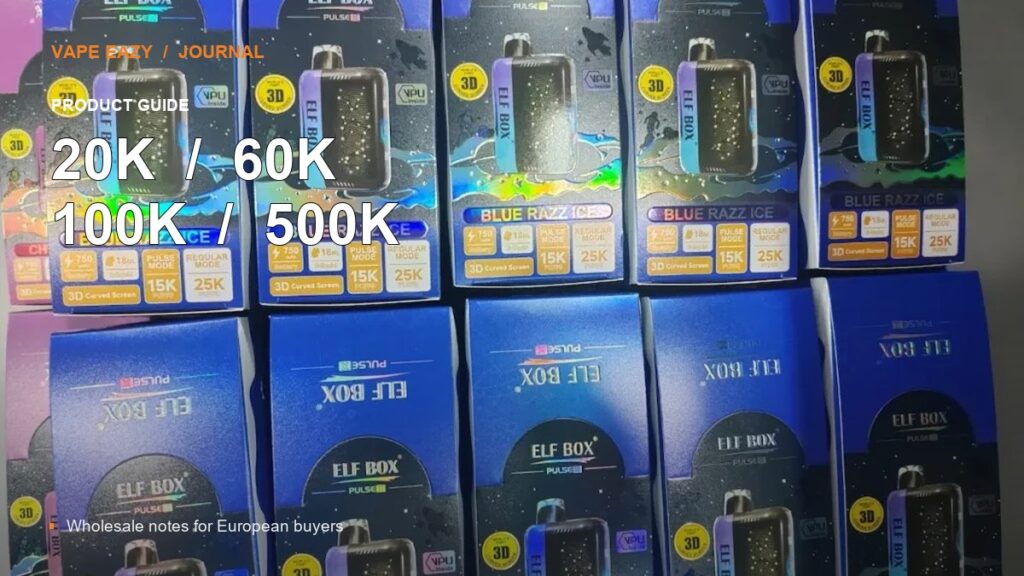
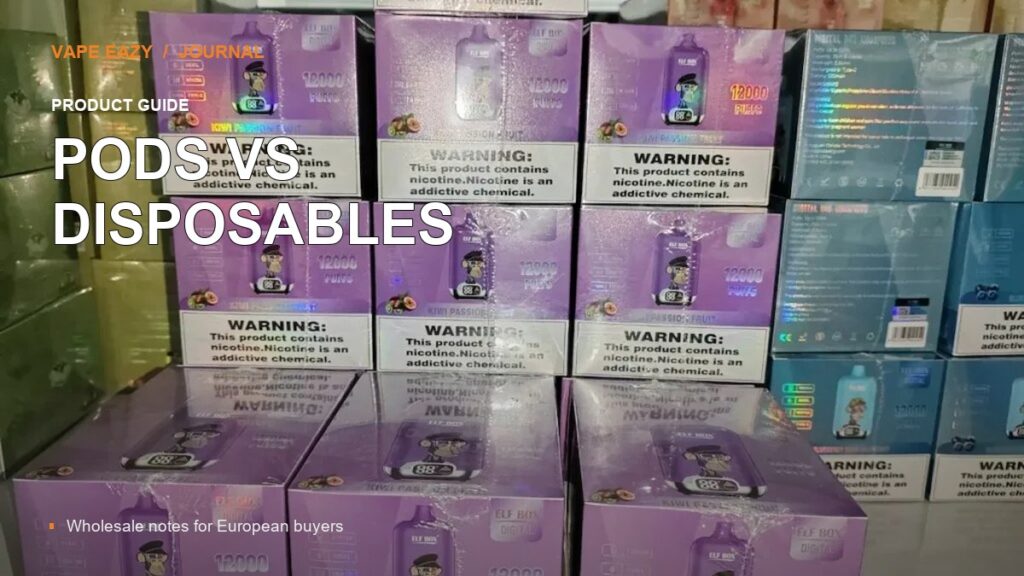
Rechargeable disposables dominate high-puff ranges, but non-rechargeable devices still have a place. Compare unit economics, shopper expectations and stock planning.
A rechargeable disposable is not automatically the better product for every shop. The right mix depends on the puff class, the retail price point, the customer’s expectation and how much support you can give at the counter. This guide compares both formats from a wholesale buyer’s perspective.
The practical difference
A non-rechargeable disposable is sealed and runs on its internal battery. A rechargeable disposable has a charging port and a battery management system, so the user can top up before the e-liquid is finished. Rechargeable devices dominate the higher puff classes because a larger battery and more liquid need more energy.
Unit economics and price points
Rechargeable devices usually cost more per unit, but they support a higher retail price and a more premium story. Non-rechargeable devices can be easier to sell at an entry price and simpler to explain. Do not compare them on unit cost alone: compare margin per unit, expected sell-through and the shelf space each line takes.
What the customer expects
At 60K puffs and above, a charging port is usually part of the value proposition. At lower puff classes, a sealed device may be the simpler choice. Retailers should stock a clear step-up: entry non-rechargeable, mid-range rechargeable, then a flagship with a display or mode switch.
Stock planning and support
Rechargeable devices mean more questions about cables, charging time and battery indicators. If your staff cannot explain the basics, the return rate and support burden can rise. Choose a supplier that gives you a specification sheet and clear charging guidance for every SKU.
A simple range rule
Use non-rechargeable devices to protect an entry price point and rechargeable devices to build a premium tier. Keep the number of charging standards small — Type-C across the range is easier for staff and customers than a mix of connectors.
Cost per puff vs unit price
A rechargeable device at a higher unit price can still be the better retail line if the customer sees more usable puffs and a premium feature set. A non-rechargeable device at a low unit price is easier to buy on impulse but may not support the same margin.
Compare the landed cost per unit with the expected retail price and the probability of a repeat purchase. Do not use the puff number as the only measure of value.
Keep the charging standard simple
A mixed drawer of micro-USB, Type-C and proprietary connectors creates support questions and returns. If possible, keep the range on Type-C and ask the supplier for the charging specification for every SKU.
FAQ
Are all high-puff disposables rechargeable?
Many high-puff devices are rechargeable, but not all. Check the specification for the charging port and battery rather than assuming from the puff number.
Do rechargeable disposables last longer?
They can use more of the e-liquid because the battery can be topped up, but actual use depends on the device and the user. The specification matters more than the label.
Can a retailer stock both formats?
Yes. A mix is common: sealed devices at entry level and rechargeable devices at higher price points.
Need stock or a quote? Browse 833 live SKUs, check the 85 brands or send a trade quote request. For market routes, see Countries.
Sourcing from this article?
Ask the trade desk.
Send the product or brand list and destination market — we will confirm stock, MOQ and route.
Request a quote